
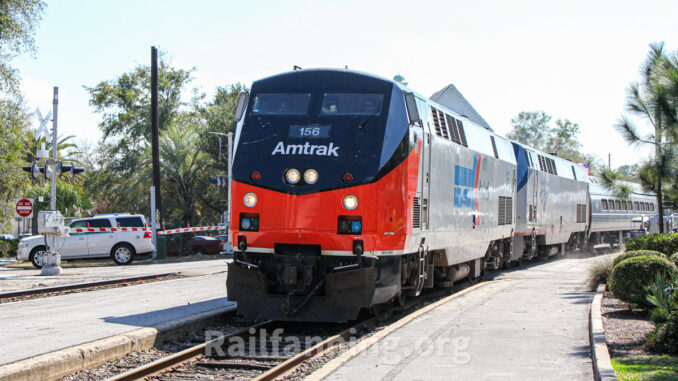
Figures released at Amtrak’s recent public meeting of the Board of Directors demonstrate the newest Amtrak service is gaining customers at strong pace.
Since Aug. 18, more than 46,000 customers have ridden Amtrak Mardi Gras Service trains on the twice-daily round trips across Coastal Mississippi between New Orleans and Mobile.
“We are well on-track to double the original estimate,” Amtrak Board Chairman Anthony “Tony” Coscia said. “Demand is very high across our network.”
Strong support has also come from three regional tourism agencies and the Southern Rail Commission.
The trains have already rocketed to the top of all services in customer satisfaction scores, due to work by Amtrak train, engine, on-board and maintenance teams. 96% of customers report being “extremely satisfied” with their trips. Amtrak board members, management and the audience applauded Amtrak employees at the annual public board meeting.
Thanks to reliable service over the CSX, Norfolk Southern and New Orleans Public Belt railroads, more than 86% of customers are on time: one of the best on-time performance scores in the Amtrak system. Even when these trains are delayed, almost 90% of customers remain extremely satisfied.
In 108 days of service, an average of more than 420 people daily rode the two round-trip buses across the Gulf Coast between Mobile and New Orleans. “Thousands of trips have been diverted from I-10 and US-90,” Mitchell added.
Ordinarily, softer ridership is expected in the first quarter of a calendar year on many routes. But this has not been a typical route, Mitchell said. “You can tell by the statistics and see by the name given to these trains: Mardi Gras,” Mitchell said.
The first of more than 40 festival parades in Mobile is on Jan. 30. In New Orleans, the Krewes start even sooner, with parades stepping off on Jan. 6. Carnival runs everywhere across this route through Fat Tuesday on Feb. 17, including Bay St. Louis, Gulfport, Biloxi and Pascagoula.
This service is sponsored by the states of Louisiana and Mississippi, in cooperation with the city of Mobile, Alabama, and the Southern Rail Commission.