
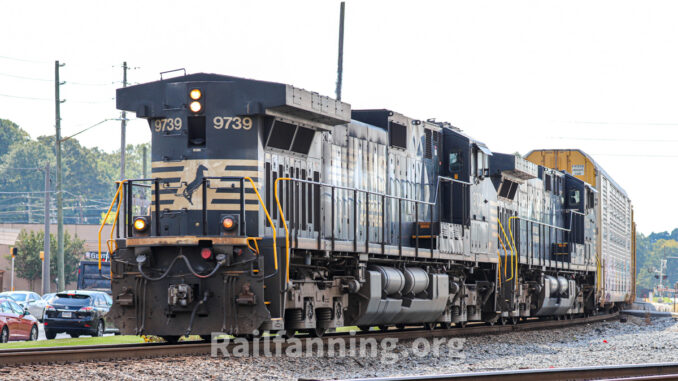
ATLANTA — Norfolk Southern Corp. has launched East Edge, a newly cleared double–stack intermodal corridor connecting Chicago and New England.
According to the company, the service reduces transit times by up to 10 hours, adds substantial network capacity and replaces a slower, single-stack route with a modern, high-efficiency double-stack route into a major eastern market.
East Edge marks a major step forward in Norfolk Southern’s decades-long strategy to handle double-stack service across its 22-state network — a journey spanning more than 40 years of engineering work and infrastructure modernization. With the new route now open, Norfolk Southern projects significant intermodal growth in this new lane over the next two years.
In a release, Norfolk Southern said rising consumer demand, the surge in e-commerce and expanding distribution hubs have long outpaced freight rail capacity in New England, pushing many shippers to rely heavily on trucking. However, company officials said East Edge directly addresses that challenge by delivering a high-capacity rail gateway in Ayer, Mass., New England’s primary intermodal hub; a faster, more resilient supply chain connection between Chicago and the Northeast; and significantly greater load flexibility and balanced network flows in the region.
The cleared route enables 9,000–foot trains to run fully double-stacked — a shift that dramatically increases the number of containers that can move through Ayer. Historically, the terminal has handled a peak of roughly 80,000 lifts annually; a single double-stacked, 9,000-foot-long train can support up to 200,000 loads annually.
Norfolk Southern said 15 miles of track were rebuilt, including more than 13,600 new crossties and 14 crossings renewed, 7 greaser pads installed, and 15 miles of brush/ditch clearing. That is in addition to new crew-change walking pads for safer, more efficient operations, clearance and structural improvements
Additionally, three bridges were raised in Massachusetts by 12 to 18 inches, 150 bridge ties and 27 culverts were replaced, and 2,000 feet of tunnel clearance were engineered in Worcester using a specialized direct-fastened floor system typically reserved for passenger rail.