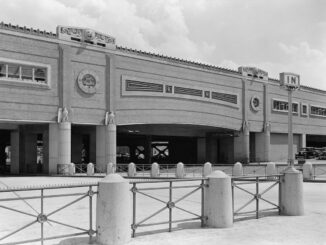
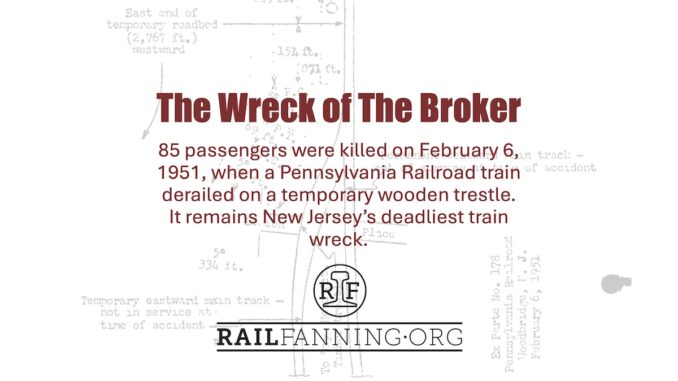
WOODBRIDGE TOWNSHIP, New Jersey — For many commuters, the evening Tuesday, Feb. 6, 1951, was a normal day at Exchange Place in Jersey City.
At 5:10 p.m., Pennsylvania Railroad train No. 733, an express train nicknamed “The Broker,” so nicknamed as it regularly hauled throngs of Wall Street workers, pulled out of the station. The Bay Head-bound train had roughly 1,000 passengers on board.
If there was anything noteworthy, it was the additional passengers, typically Jersey Central commuters, who crammed into the 11-car train, with locomotive No. 2445, a 4-6-2 steamer of the K4 class, at the front. The Central was out of service thanks to a six-day work stoppage.
That afternoon, rail traffic through Woodbridge was rerouted onto a temporary trestle and shoofly near Fulton Street to allow workers to build the New Jersey Turnpike. A notice sent to train engineers indicated that starting at 1:01 p.m. that day, trains were to reduce speed through Woodbridge to 25 mph instead of the usual 60 mph.
The Pennsylvania Railroad, however, did not require any warnings for approaching trains, believing verbal notifications were sufficient.
Before “The Broker” departed Jersey City, conductor John Bishop reminded engineman Joseph Fitzsimmons of the speed limit. Despite this, Fitzsimmons did not slow the train as it neared Woodbridge.
It was traveling at roughly 50 mph. Bishop, alarmed by the speed, tried to pull the emergency cord but was unable to because of the crowded conditions.
At 5:43 p.m., the tracks shifted under the locomotive, causing eight of the eleven passenger cars to derail.
The first two cars fell onto their sides, while the third and fourth collided as they went down a 26-foot-high embankment, resulting in most of the 85 fatalities. The fifth and sixth cars hung over a street slick with rain, and some passengers may have jumped, thinking they would land in water.
In total, 85 people — 84 passengers and one railroad employee — were killed. Another roughly 500 passengers and 5 railroad employees were injured.
At a Feb. 9, 1951, meeting of the Interstate Commerce Commission and the New Jersey Public Utility Commission into the wreck, New Jersey Deputy State Attorney General Benjamin C. Van Tine blasted the railroad’s “shipshod methods taking care of the safety of the people,” the Associated Press Reported at the time.
The Interstate Commerce Commission determined the primary cause to be excessive speed on a curve of a temporary track, which had limited structural support and was ballasted with cinders rather than crushed stone. The track shifted laterally under the train’s weight, leading to the derailment.
Additionally, the lack of automatic train-control systems to enforce speed restrictions, the absence of warning signals to alert the crew to the speed-restricted area, and miscommunication or oversight regarding General Order No. 1806, which outlined the speed restrictions, were contributing factors to the calamity, according to an investigation.
According to reports, Fitzsimmons, who continued to work for the Pennsylvania Railroad until 1953, but never engineered a train again, was accustomed to the warning signals used on a different division and overlooked their absence on this route.
The commission recommended installing an automatic train-control system on the New York Division to enforce speed restrictions and to use adequate warning signs to indicate temporary speed restriction zones, unless protected by automatic systems.