
The federal rules governing when a locomotive engineer sounds the horn have taken another turn.
On Aug. 31, the Federal Railroad Administration issued a final rule clarifying that federal regulations do not require railroads to sound locomotive horns simply because a train is approaching or passing through a passenger station. Railroads can set their own station-horn policies through internal operating rules, and if a railroad chooses to sound a horn at a station, the minimum sound requirements in federal locomotive safety standards won’t apply.
“In response to this feedback, FRA notes that the rule is intended to clarify existing discretion for railroads over locomotive horn use at passenger stations; it imposes no change on this existing discretion,” according to the rule.
“Accordingly, there is no reason to expect any increase in public safety incidents in connection with railroads’ exercise of this discretion whether to sound the locomotive horn at passenger stations under their own operating rules,” it continued. “Nor will a railroad’s exercise of this discretion when sounding the locomotive horn under their operating rules make a railroad non-compliant with the requirements of” federal law.
Followers of the long fight over train horns might read that as a walk-back of federal oversight. It’s actually addressing a question the existing rules never really answered.
Railfanning.org’s previous reporting reveals a regulatory system built around a narrower problem: when trains should sound their horns at highway-rail grade crossings, where the horn warns motorists and pedestrians who might otherwise wander into a train’s path.
The grade-crossing framework goes back two decades. A passenger station is a different kind of place — nobody’s driving across the tracks there — and FRA’s new rule reflects that a platform doesn’t need the same federal baseline as a grade crossing.
In September 2004, Railfanning.org reported that CSX Transportation had begun horn-free operations on a four-mile stretch of track through Blue Island, Evergreen Park and Chicago, establishing Illinois’s first quiet zone built to the coming federal standard. Reaching that point meant median barriers at some crossings, four-quadrant gates at another, one private crossing closed outright and another relocated.
The work ran about $3 million, funded through an Illinois Commerce Commission grant.
The following spring, FRA established the modern federal framework. The June 2005 edition of The Cross-Tie reported that FRA’s Final Train Horn Rule generally required locomotive horns at public highway-rail grade crossings, while giving communities a process to create quiet zones when they met specified safety requirements.
At minimum, new quiet zones required flashing lights and gates at every public crossing. Depending on risk, communities could be required to install additional protections to compensate for the absence of the locomotive horn.
The rule also set the first federal maximum train-horn volume and reduced the time horns were required to sound. FRA described the objective as balancing safety with quality-of-life concerns.
Not every railroad has embraced the tradeoff. Union Pacific’s public position is that quiet zones compromise safety for its employees and the public, even as the railroad complies with the ones that meet federal requirements.
That tension has hardly disappeared. Savannah spent roughly a decade working with CSX, its short-line operator Watco, and the Georgia Department of Transportation before a federally designated quiet zone finally took effect along its Old Fort rail line in January 2024.
Dallas Area Rapid Transit ran into a similar problem more recently while testing its new 26-mile Silver Line. Trains sounded their horns at every crossing during testing, as required, and DART worked with FRA and six of the seven cities along the route to install quiet zones before regular passenger service began.
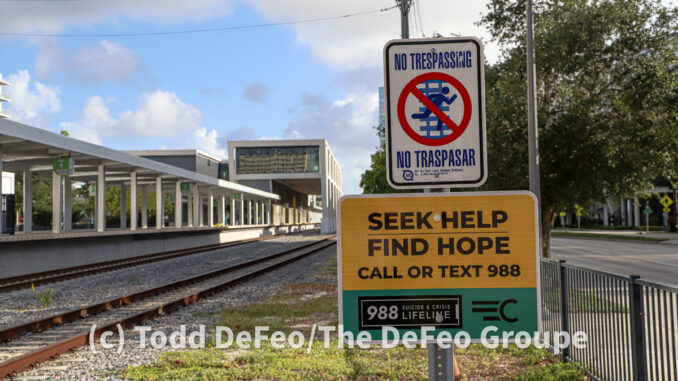
However, that is not what the Aug. 31 rule is about. A passenger station isn’t a grade crossing, and FRA is now saying plainly that a station’s existence, by itself, doesn’t trigger a federal horn requirement.
Whether to sound one there is a call the railroad is empowered to make.

Be the first to comment