
Overview
The arrival of the railroad had an immediate impact on Newark. In 1830, Newark boasted a population of about 11,000, but by 1850, the city had a population of more than 38,000. The Pennsylvania Railroad opened a new station in Newark circa 1891. About two years later, the railroad elevated its tracks through the city.
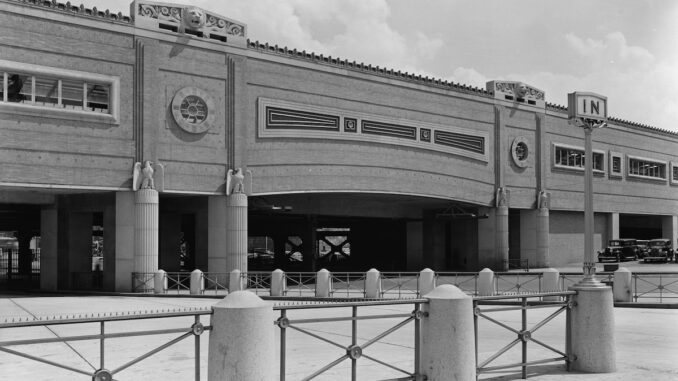
Opened on March 24, 1935, the Pennsylvania Railroad built Newark Penn Station as part of its ambitious program to electrify the line between New York and Washington, replacing an earlier depot dating to the late 19th century.
Designed by the famed architectural firm McKim, Mead & White, the station combines Art Deco and Neo-Classical elements. From the beginning, it served as more than a railroad terminal. The station brought together intercity trains, commuter rail service, streetcars, buses, and the Hudson & Manhattan Railroad (today’s PATH), making it one of the region’s first true intermodal transportation hubs.
The station played a vital role during World War II and remained an important transportation center even as rail travel declined after the war. Today, Newark Penn Station serves Amtrak, New Jersey Transit, and PATH trains, continuing its role as a gateway between New Jersey, New York City, and the broader Northeast Corridor. Its enduring significance reflects Newark’s historic place in the development of American rail transportation.
Quick Facts
- Status
- Existing
- Community
- Newark
- State or province
- New Jersey
- Country
- United States of America
- Address
- 1 Raymond Plaza West &, Market St, Newark, NJ 07102
- Coordinates
- 40.734764956225135, -74.1641643160579
- Opened or constructed
- March 24, 1935
Railroads and Organizations
Happening
March 24, 1935