
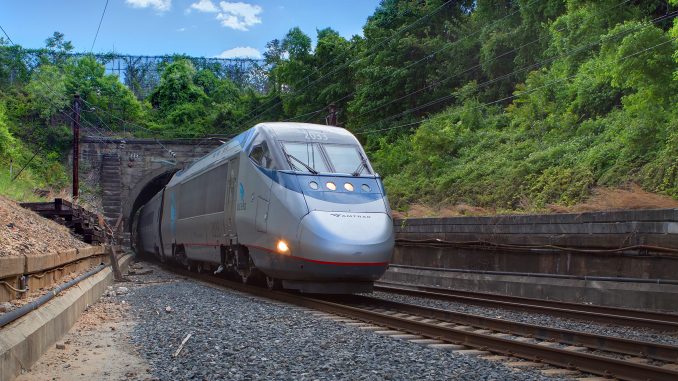
Rail passengers traveling on the Northeast Corridor between Washington and Baltimore will see increased construction activity at the B&P Tunnel Replacement Program site as Amtrak’s tunneling contractor prepares to launch the first of two tunnel boring machines in 2028.
Following more than a year of evaluations, Amtrak and the Federal Railroad Administration identified opportunities to optimize the program’s design, improve construction and scheduling, and address cost pressures.
Amtrak also has advanced work to prepare for realignment of the Northeast Corridor south of the future tunnels, including utility relocations and replacement of the Mulberry Street Bridge.
Construction has accelerated since the first major contract was awarded in late 2023 and utility relocation began in 2024. Much of the work is visible to passengers traveling between the West Baltimore MARC station and the south portal of the existing B&P Tunnel.
Amtrak and its contractors have advanced work on the new Mulberry Street railroad bridge, including excavation and construction of the initial footings. The bridge is the first of five that will be reconstructed as part of the program.
Manufacturing also is underway on two tunnel boring machines that will construct the new tunnel tubes. The first machine is more than 50% complete.
Crews also reached a major milestone on a new 345-foot utility tunnel. When completed in 2027, it will carry water, sewer, communications and electrical utilities beneath the existing and future Northeast Corridor tracks.
The existing 1.4-mile B&P Tunnel is the oldest Amtrak tunnel and a single point of failure for the 15 million Amtrak and MARC customers who rely on it. Opened in 1873, the tunnel suffers from a variety of age-related issues, leading to frequent delays and extensive maintenance needs.
Officials said the tunnel is at capacity, and its tight curves limit train speeds to a maximum of 30 mph.