
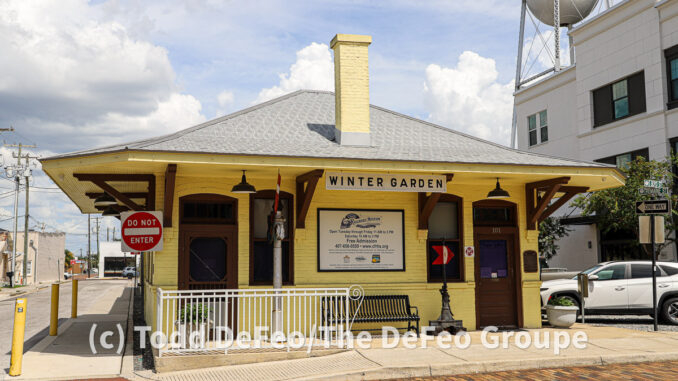
WINTER GARDEN, Florida (Railfanning.org News Wire) — Railroad historian and author Todd DeFeo used his presentation at the Central Florida Railroad Museum to share new research into some of the deadliest railroad disasters in American history, arguing that while technology has changed dramatically since the earliest days of railroading, one factor has remained stubbornly consistent: people.
During the talk,“Death on the Rails in Florida and Beyond,” DeFeo said he analyzed what he believes are 50 of the deadliest railroad wrecks in U.S. history to better understand why major rail disasters happened. He cautioned that the list is not perfect, because railroad-disaster data, especially from the 19th and early 20th centuries, is often incomplete, inconsistent or distorted by conflicting newspaper reports.
“What I decided to do was limit my scope a little bit,” DeFeo told the audience. “I took 50 of the deadliest wrecks. I think they’re the 50 deadliest wrecks. They may not be the exact 50 deadliest wrecks, but they’re certainly on the top, and I started looking at what caused them.”
DeFeo said the research revealed a clear pattern. Based on his calculations, about 60 percent of the wrecks in the sample were caused by human error, while 14 percent involved infrastructure failures and about 12 percent were caused by weather. He emphasized that the categories are subjective, since some disasters could reasonably be classified in more than one way.
As an example, DeFeo pointed to the Ashtabula River bridge collapse of Dec. 29, 1876, in which 92 people were killed and 64 injured. He said that case could be viewed as an infrastructure failure because a bridge collapsed, but it also could be viewed as human error if the bridge design or construction was flawed. For his analysis, DeFeo classified the disaster as an infrastructure failure.
“I say all this to say, a lot of this data is a bit subjective and it’s open to some level of interpretation,” DeFeo said. “Somebody looking at the same set of data could come up with slightly different conclusions.”
The analysis grew out of a broader research project in which DeFeo has compiled a database of hundreds of railroad mishaps, ranging from major disasters to smaller one-off incidents. He told the audience that the database is still only a fraction of the wrecks that have occurred over the decades, but that it provides a way to examine patterns across time.
DeFeo said one of the central challenges is that early railroad disasters were not investigated or recorded with the consistency expected today. Newspaper accounts often gave conflicting death tolls, and those numbers sometimes grew as stories were repeated around the country.
The problem is not limited to obscure wrecks, DeFeo said. He pointed to the 1918 Nashville wreck at Dutchman’s Curve, often cited as the deadliest railroad wreck in U.S. history. The Interstate Commerce Commission reported 101 deaths, but DeFeo said his work with newspaper accounts, burial records and death certificates suggests the toll may have been higher, perhaps in the 120 range, though he stressed that certainty may never be possible.
That uncertainty, DeFeo said, is part of what makes railroad-disaster research both compelling and frustrating. Even when official records exist, they do not always settle every question. In the Nashville case, he said he located about 75 death certificates in Tennessee archives that appeared tied to the wreck, which still did not fully match the official death toll.
The findings also shaped DeFeo’s discussion of modern railroad safety. He said many people searching for Florida railroad deaths today encounter mostly information about Brightline, but he cautioned that a direct comparison between modern Brightline fatalities and 19th-century railroad deaths is difficult because the data, population, operating conditions and exposure levels are so different.
Still, DeFeo said the comparison underscored a broader continuity. Early railroads killed people walking or lingering on tracks, while modern railroads operate through denser environments with larger trains, higher speeds, vehicles, pedestrians and grade crossings. The technology has changed, he said, but the human factor has not.
“What I did conclude is that people are often in places and doing stuff that they shouldn’t be doing,” DeFeo said. “Trains have changed, the equipment has changed, it’s gotten bigger, the technology’s changed, but again, there’s one element that has not changed, and that would be the people.”
DeFeo illustrated that point with the 1956 Pineola wreck near Floral City, Florida, where two Atlantic Coast Line freight trains collided head-on after a dispatcher routed a northbound train against the current of traffic while a southbound train was already occupying the same track. Four railroad employees died in the crash.
For DeFeo, the Pineola wreck showed how a single human mistake could turn an ordinary operating decision into a fatal disaster. He described the sequence of events, including the broken coupler that delayed one train, the dispatcher’s decision to route another train around the delay, and the failure to recognize that a train had already left Dunnellon on the same track.
The presentation closed by connecting the research back to memory and place. DeFeo said he had recently walked near Dutchman’s Curve in Nashville and along the trail near the Pineola wreck site, where people now bike or stroll without necessarily knowing what happened there decades earlier. He described the contrast as emblematic of railroad-disaster history: a site of death can become a peaceful public space, while the memory of the event fades.
“A scene of death yesterday is a peaceful bike trail today,” DeFeo said. “We forget what happened.”
DeFeo said he expects to continue researching railroad deaths because the subject remains vast and incomplete.
“The more I explore, the more I realize that it’s probably not possible,” DeFeo said. “There are so many wrecks out there. There are so many stories that are out there.”