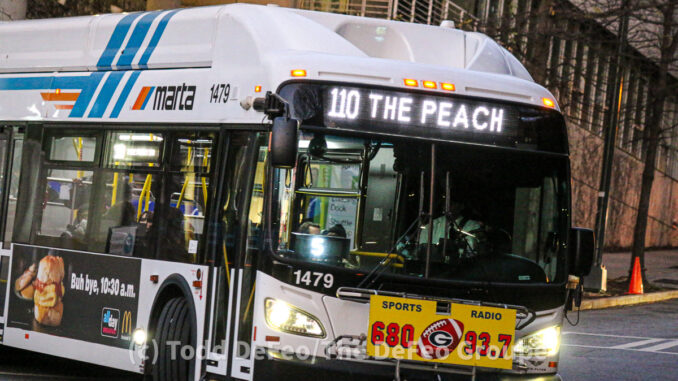
The Georgia Supreme Court on Aug. 18 declined to hear a case against MARTA, leaving in place a Court of Appeals ruling involving MARTA’s duty toward passengers aboard its buses.
Four justices dissented from the denial, while Justice Carla Wong McMillian Colvin was disqualified. The court did not include an opinion explaining why it denied a petition to consider the case.
The underlying case stems from a Jan. 22, 2022, MARTA bus trip. According to Justice Andrew Pinson’s dissent, Kadiatou Sanoh boarded after work and discovered her Breeze card was a few cents short of the fare.
While she searched her purse for change, the bus accelerated from the stop and then braked when a car pulled in front of it. Sanoh, who was standing and bracing herself with one hand, was thrown forward into a railing and suffered significant injuries.
The Court of Appeals ruled that MARTA “has no duty to give passengers a reasonable time to find a seat before departing the station,” according to the Supreme Court dissenting opinion.
Pinson argued that ruling effectively removes from juries a question that Georgia law generally leaves to them: whether a common carrier exercised the required “extraordinary diligence” to protect passengers. He said the Court of Appeals rule could bar claims even when a driver accelerated knowing a passenger was elderly, disabled or otherwise not secure.
“There can be no real dispute that MARTA owes a duty of extraordinary diligence to protect its passengers,” Pinson wrote. “The real question was whether MARTA had breached that duty under the circumstances of this case. And the court’s holding, in effect, was that, as a matter of law, MARTA does not breach its duty of extraordinary diligence by not giving a passenger enough time to sit down or otherwise secure herself on a MARTA bus.
“I am not so sure about that,” Pinson added. “What if a bus driver mashes the accelerator immediately after closing the bus doors, when most of the new riders are still looking for seats? What if he does so even after someone asks him to wait? Or what if the driver notices an elderly or disabled person has not yet found a seat, and still hits the gas? Would a ‘very prudent and thoughtful’ bus driver exercising “extreme care and caution” do any of those things?”
The dissent did not say Sanoh necessarily should win. Rather, Pinson argued the Supreme Court should have taken the case to determine when these passenger-injury cases may properly be dismissed as a matter of law and when a jury should decide whether MARTA exercised extraordinary diligence.
Chief Justice Nels Peterson and Justices John Ellington and Verda Colvin Land joined Pinson’s dissent.