
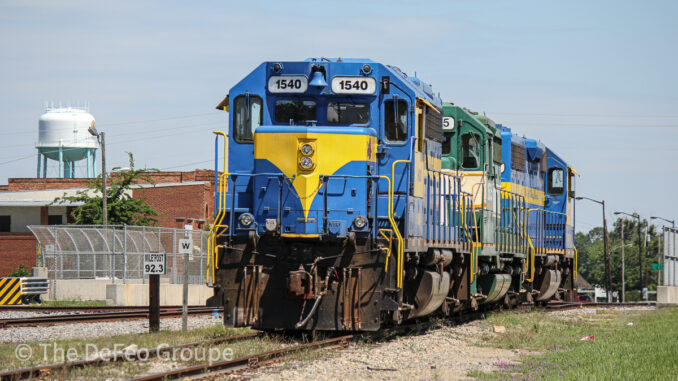
(Railfanning.org News Wire) — Half a century ago, Georgia lawmakers authorized state intervention to prevent widespread rail abandonments.
Now, a new state-commissioned audit of Georgia’s Railroad Track Maintenance Tax Credit has renewed debate over how best to sustain rural freight rail service.
Prepared by Georgia Southern University’s Center for Business Analytics and Economic Research for the Georgia Department of Audits and Accounts, the analysis estimates the Class III tax credit will reduce state revenue by roughly $5.95 million in 2026 while generating $3.64 million in economic value added. Researchers concluded that only about 25% of qualifying track spending is directly attributable to the incentive.
The credit expires after the 2026 tax year, prompting questions over whether the state is subsidizing routine maintenance railroads would perform regardless.
“The credit is achieving its goal of aiding the ongoing operations of Class III railroads in Georgia,” the report said.
“If the credit were renewed or extended, some modifications could increase its use and efficiency and return on investment to the state,” the report added. “Most of the spending on track maintenance would have occurred without the credit; the principal ways to improve the state’s return are therefore to increase the share of credit-supported spending that is caused by the credit, to reduce the amount of credit paid on maintenance that would have occurred anyway, and to better capture public benefits.”
Amid carrier bankruptcies, deteriorating branch lines, and accelerating abandonments that threatened rural agricultural and manufacturing shippers, the Georgia General Assembly authorized the Georgia Department of Transportation to offer financial assistance and acquire threatened corridors to preserve essential freight service. The measure was codified as Official Code of Georgia Section 32-9-6.
State intervention expanded following the federal Staggers Rail Act of 1980, which allowed Class I railroads to shed marginal branch lines.
Through GDOT’s Intermodal Division, Georgia has acquired roughly 540 miles of track, including roughly 465 active miles, according to a recent estimate. The state contracts with private short-line lessees, including the Chattooga & Chickamauga Railway, CaterParrott Railnet, Georgia Northeastern Railroad, Georgia Southwestern Railroad, Heart of Georgia Railroad, and Ogeechee Railroad Company, separate from the historic Western & Atlantic Railroad leased to CSX Transportation.
State capital support for those corridors has fluctuated alongside shifting budget priorities, rising from roughly $7.9 million annually between fiscal 2014 and 2018 to $35 million for track upgrades in fiscal 2020, and nearly $13.8 million in fiscal 2025. Georgia’s 28 short line railroads operate approximately 1,538 route miles, nearly 30% of the state’s active rail network.
Be the first to comment