
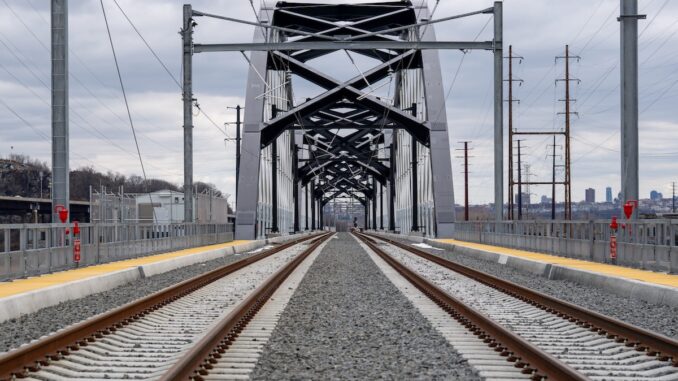
NJ Transit and Amtrak have started operating passenger trains over one of the new Portal North Bridge’s two tracks, shifting trains off the 116-year-old Portal Bridge.
The swing span over the Hackensack River has long been a choke point for rail traffic between Newark and New York. Officials said the second and final track is expected to move onto the new bridge in the fall, a change intended to improve reliability for NJ Transit and Amtrak riders for decades.
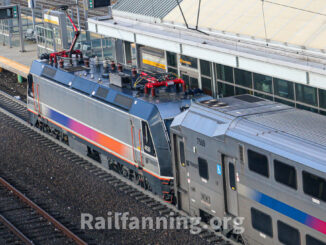
The ceremonial train was led by an NJ Transit locomotive wrapped in graphics tied to America’s 250th anniversary.
Work to transfer service began Feb. 13 and required temporary schedule adjustments for NJ Transit and Amtrak while crews connected the new bridge to the existing rail network. Officials said regular NJ Transit schedules will resume Sunday, March 15, and urged riders to check updated timetables.
The Portal North Bridge is a two-track, high-level, fixed-span replacement designed to eliminate bridge openings that routinely halt trains for marine traffic. The new span rises about 50 feet above the Hackensack River — roughly double the clearance of the existing bridge — allowing boats to pass beneath without interrupting rail service.
The project is funded by the U.S. Department of Transportation, New Jersey, New York and Amtrak. A full funding grant agreement signed in January 2021 secured $766.5 million in Federal Transit Administration support, and NJ Transit awarded a $1.56 billion construction contract in October 2021 to the Skanska/Traylor Bros. joint venture.
NJ Transit said the contract was the largest single construction award in its history.
The work covers 2.44 miles along the Northeast Corridor and includes retaining walls, deep foundations, concrete piers, structural steel spans, track systems and demolition of the old bridge. The Portal North Bridge is a key component of the broader Gateway Program, which aims to eventually double rail capacity between Newark and New York.
Officials said the existing Portal Bridge is scheduled for dismantlement next year.
Be the first to comment