
SAVANNAH, Georgia – The Georgia Ports Authority has issued a letter of intent to Assistant Secretary of the Army for Civil Works Adam Telle, detailing GPA’s plans to start a Savannah Harbor modification study.
GPA will work closely with the U.S. Army Corps of Engineers to complete the study under the authority of Section 203 of the Water Resources Development Act. The study will consider deepening the channel and adding passing lanes for two-way ship traffic.
It was authorized under WRDA 2024, with initial funding of $500,000 awarded in the fiscal 2026 budget from Congress.
The Corps of Engineers will provide technical assistance and will retain final review and approval authority, including oversight of environmental and economic analyses. The Corps’ feasibility study for the previous Savannah Harbor expansion found $7.70 in economic benefit to the nation for every dollar spent on construction.
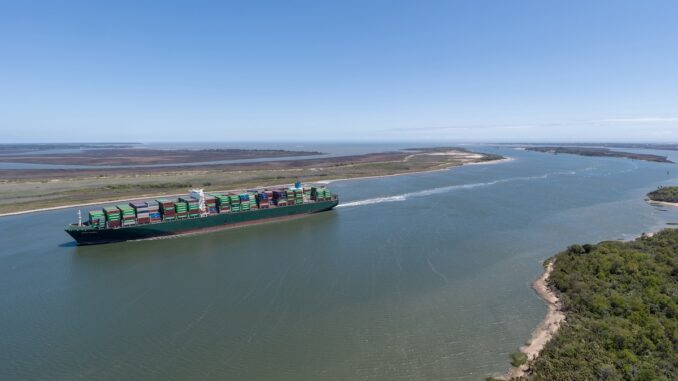
A deeper harbor is needed to allow large ships to load more cargo and avoid tidal delays. Passing lanes will allow arriving and departing ships to transit the channel simultaneously, for faster vessel service. The Port of Savannah is now serving vessels capable of carrying more than 16,000 twenty-foot equivalent container units – twice the size the channel is designed to accommodate.
The Savannah Harbor modifications feasibility study will assess market demand for the port and establish a vessel class for the design of any proposed deepening. The process will include projecting which size ship will be most common in Savannah’s future, then designing harbor modifications to suit that vessel class.
The study will then examine any impacts modifications might have on the estuary, as well as potential economic benefits for the nation.
The Savannah River shipping channel has been expanded three times for navigation purposes: in 1945, 1994 and 2022. The first expansion, in 1945, dredged the river to a depth of 38 feet. In 1994, the channel was deepened to 42 feet, and in 2022, the Savannah Harbor Expansion Project deepened it to 47 feet.
Federal impact studies and seven years of construction meant SHEP was completed more than 20 years after its original design, which anticipated that 8,200-TEU vessels would be the main workhorses on the U.S. East Coast. Once the study is finished, the Corps will recommend to Congress whether to expand the Savannah Harbor.
The project would then require additional authorization from Congress, followed by federal and non-federal funding for construction.