
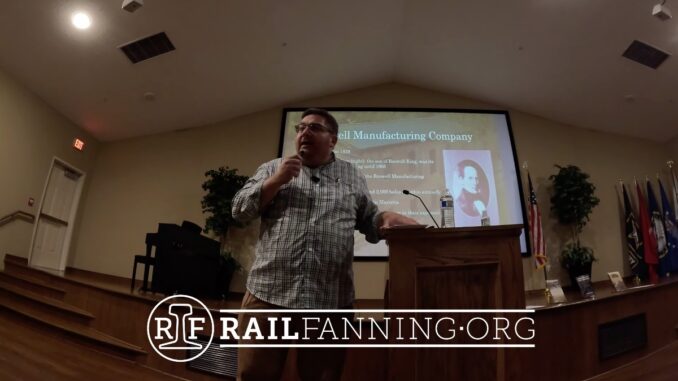
ROSWELL, Georgia (Railfanning.org News Wire) — Historian and author Todd DeFeo discussed the Western & Atlantic Railroad and Roswell’s long-running effort to connect with Georgia’s rail network during a presentation this week in Roswell.
The talk, titled “People and Places of the Western & Atlantic Railroad, and How Roswell Almost Connected,” examined the role the state-owned Western & Atlantic played in developing North Georgia, creating Atlanta and influencing nearby communities that sought access to the region’s growing railroad system.
DeFeo, the publisher and editor of Railfanning.org, said Roswell is a great example of a locality that understood the value of railroad access but never quite secured the connection its leaders originally conceived.
“For a city that’s never had any railroads, Roswell has an interesting railroad history,” DeFeo told the audience. “It’s certainly not the only city in America that falls in this category.
“…It’s really the perfect city to illustrate a key point of railroad history: The story of railroads isn’t always about success,” DeFeo added. “Sometimes it’s a story of trial and error. Many times it’s a story of falling short. And really, that’s the story of Roswell’s railroad history. But falling short of ambitions isn’t always for lack of trying. Sometimes fortune isn’t in your favor. Sometimes there are other factors at play. Maybe there’s a river to cross, or there’s a war that’s raging that alters your plans.”
The presentation traced Roswell’s railroad ambitions to the mid-19th century, when the Roswell Manufacturing Company was a major local industry. By 1849, the mill operated dozens of looms and thousands of spindles, but its nearest railroad depot was in Marietta, about 13 miles away.
That distance, DeFeo noted, helped explain why Roswell leaders sought a rail connection to the state-owned Western & Atlantic.
Roswell’s rail hopes led to the 1863 chartering of the Atlanta & Roswell Railroad Company, which contemplated a connection with the Western & Atlantic. However, the Civil War delayed the project, and in the years that followed, the effort shifted toward the Atlanta & Richmond Air-Line Railway.
That shift proved consequential. When the Air-Line faltered after the Panic of 1873, the Atlanta & Roswell was drawn into financial trouble. Contractor Grant, Alexander & Co. obtained a judgment against the company, and the railroad’s property was later sold and reorganized.
The line finally became reality in 1881 as the Roswell Railroad, initially a narrow-gauge branch tied to the Atlanta & Charlotte Air Line Railway. But it was not the Atlanta, Marietta or Western & Atlantic connection its backers initially planned.
DeFeo said the Roswell story remains compelling because it is not simply about a railroad that was built, but about the connection that almost happened.