Positive train control was supposed to fix some of the railroad’s oldest safety problems. Two decades later, the old problems are still worth watching.
Twenty years after Railfanning.org first wrote about federal investment in Positive Train Control, the Federal Railroad Administration is reminding the industry that some of the oldest — and less technology-dependent — protections still matter.
The FRA issued a safety advisory on Sept. 3 concerning trains operating at restricted speed, including movements in territory protected by PTC. The advisory arrives after two decades that have reshaped railroad safety technology in ways few people could have predicted back when this all started.
“While the overall safety of railroad operations has improved in recent years, a series of accidents has highlighted the need for railroads to review, to reemphasize, and to adhere to Federal regulations and railroad operating rules and procedures governing the requirements of restricted speed, including in PTC territory,” the FRA said in its advisory.
“…PTC is a safety overlay that, among other things, enforces specified speed limits, preventing certain classes of human-performance errors,” the FRA added. “Nevertheless, FRA is concerned about the safety implications of overreliance on PTC, particularly when PTC is used in Restricted Mode. In many system configurations, PTC’s use in Restricted Mode enforces the upper limit of restricted speed; however, the crew remains responsible for ensuring the train can be stopped within one half their range of vision.”
The Road to PTC
In August 2006, the FRA awarded a $679,000 grant to keep advancing PTC development. The goal was straightforward: prevent train collisions, reduce the risk of speed-related derailments, and protect the people working on the tracks.
At that point, the government and the railroad industry were still hammering out how PTC would actually work in practice. However, two years later, the political calculus changed.
On Sept. 12, 2008, a Metrolink commuter train collided head-on with a Union Pacific freight train in the Chatsworth section of Los Angeles. Twenty-five people died, and 135 were injured. Lawmakers argued that PTC could have prevented the collision, and Congress responded with the Rail Safety Improvement Act of 2008, mandating PTC on much of the nation’s major freight and passenger rail network.
Putting PTC in place took far longer than anyone expected.
The original deadline was 2015.
Congress pushed it back, and Railfanning.org spent much of the next decade tracking the industry’s slow progress. In June 2018, BNSF and Amtrak activated PTC on several BNSF subdivisions used by the Southwest Chief and California Zephyr. By December 2019, the FRA reported that most of the 42 railroads subject to the mandate were either running PTC in revenue service or conducting advanced field testing.
Railroads finished the required work at the end of 2020. Today the system covers almost 59,000 route miles, based on FRA numbers Railfanning.org reported in 2024.
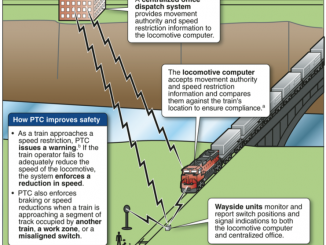
PTC can stop several types of accidents that railroaders once had to prevent through rules and experience alone. It intervenes when a train runs too fast, passes certain limits, or triggers other conditions the system is built to catch.
But PTC didn’t make the old railroad rules disappear.
Case in Point
A 2024 collision near Folkston, Georgia, illustrates the distinction. Three crew members were hospitalized after a CSX intermodal train struck a stationary rock train head-on, having passed through an improperly lined switch during a signal suspension. The NTSB later found that insufficient training and CSX’s failure to implement key procedures — including a restricted-speed requirement and secondary verification of switch position — contributed to the accident.
The signals in the area had been suspended for maintenance and upgrades. Train movements were governed by track warrants, and a conductor manually operated the switches.
It was exactly the kind of unusual situation where technology, procedure, and human judgment all have to work together.
By 2026, the railroad industry has a layer of safety technology that didn’t exist when Railfanning.org first started covering PTC in 2006. But the older approach, reliant on human intuition, never fully left. This latest advisory reminds the industry that it can’t.