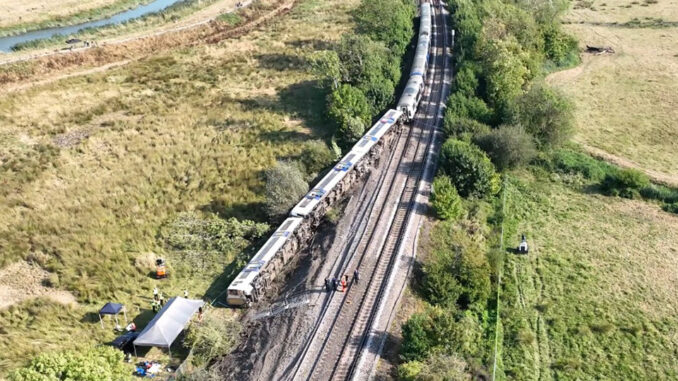
A “track geometry irregularity” was present shortly before a Southern passenger train derailed near Lewes, England, leaving 30 people injured and overturning three carriages, the Rail Accident Investigation Branch said in a preliminary update.
About 150 people were aboard the London Victoria-to-Eastbourne service when it derailed about 1 mile north of Lewes station at around 3:54 p.m. on Aug. 13. Twenty people required hospital treatment, some with serious injuries. The derailment caused significant damage to the train and railway infrastructure.
The RAIB has not determined that the track irregularity caused the derailment and is examining the condition and maintenance of the track and surrounding embankment, as well as the possible effects of sustained hot, dry weather. Investigators stressed that their work is continuing and information may change as more evidence is analyzed.
Train 1F34 consisted of eight cars formed from two four-car Class 387 electric multiple units operated by Southern, part of Greater Thameslink Railway. The rear three cars derailed and overturned, coming to rest on their sides on the railway embankment. The front five remained on the tracks.
Preliminary data from the train’s on-board recorder shows it was traveling about 65 mph as it approached the derailment point, below the 70 mph maximum permitted speed for that type of train at the location. The data indicate that the driver applied the brakes as the train passed the derailment point and began slowing.
Investigators found marks on the rails consistent with the rear cars’ wheels climbing over them.
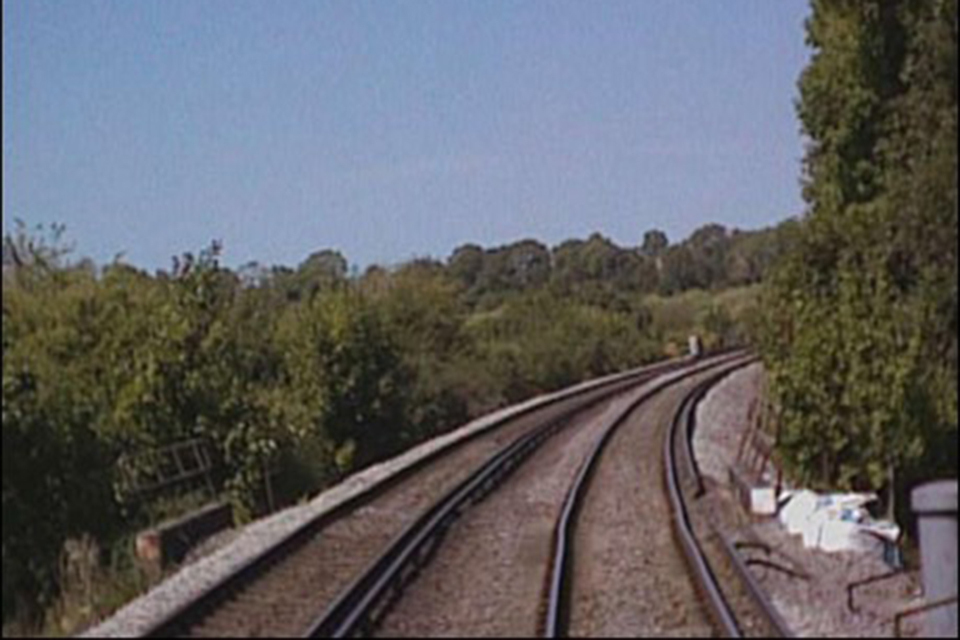
CCTV footage from the derailed train and from services that traveled over the route earlier on Aug. 13 shows a track geometry irregularity in the immediate approach to the derailment point, according to the RAIB. Investigators also found evidence of previous track maintenance in the area and said passengers on other trains have since reported rough riding at the location.
The accident occurred during sustained hot, dry weather, with temperatures around 27 degrees Celsius (81 degrees Fahrenheit). Investigators are also examining the clay embankment beneath the railway, which can move as moisture levels change. The RAIB said there is currently no evidence of a significant embankment slip immediately before the crash, although evidence indicates some movement had occurred previously.
The investigation will examine the derailment mechanism, track and embankment maintenance, hot-weather precautions, the train’s condition and crashworthiness, the emergency response and any actions taken following previous safety recommendations. The RAIB said it will publish its findings and any safety recommendations when the investigation is complete.