
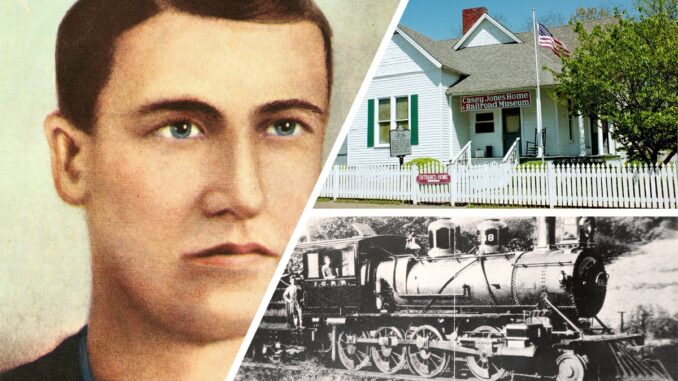
Casey Jones became a railroad legend after his death. Simeon Taylor “Sim” Webb lived for another 57 years and helped tell the world what happened during Jones’s final run.
Webb, born May 12, 1874, was the Illinois Central Railroad fireman working with Jones when the passenger train they were operating crashed at Vaughan, Mississippi, on April 30, 1900. Jones died in the wreck. Webb survived.
Their train, pulled by Illinois Central No. 382, was running from Memphis toward Canton, Mississippi. Jones had taken the run after another engineer couldn’t work, and the train departed Memphis well behind schedule. By the time it approached Vaughan, Jones had made up much of the lost time.
Webb told the story again and again over the decades that followed, and it barely changed.
In a first-person account published in 1955, Webb said the train left Memphis an hour and 35 minutes late. As it rounded a curve at Vaughan, he and Jones saw an obstruction on the main line ahead. Jones went for the throttle and whistle and ordered Webb to jump, and he did.
He remembered rolling off the locomotive, certain at first that Jones was right behind him. When he came to after the collision, Jones was dead. Webb said that had he known Jones intended to stay aboard, he would have stayed in the cab with him.
That sequence became central to the Casey Jones story. Jones stayed with the locomotive and tried to slow his train before it struck freight equipment fouling the route. He was the only person killed.
Songs, newspaper stories and later retellings transformed Jones into one of the best-known figures in American railroad folklore. Webb, however, remained one of the few people who could describe the final moments from inside the locomotive cab.
Newspapers kept seeking him out for decades after the wreck.
A 1951 profile revisited the accident more than half a century later, recounting Webb’s railroad career and his memories of working with Jones. A 1955 United Press account again placed Webb’s recollections at the center of the story.
His recollections also show how hard it is to separate the historical wreck from the legend that grew around it. Details changed among newspaper accounts, and even contemporary explanations of how the freight train came to obstruct the main line were not always identical.
Webb’s account remained remarkably consistent about the moment that defined his role: Jones saw danger ahead, ordered his fireman to jump, and stayed at the controls.
Webb continued with the Illinois Central for years after the wreck. By the 1950s, he was retired and living in Memphis with his wife, Pearl. They had three daughters and a growing number of grandchildren.
Webb died in Memphis on July 13, 1957, at age 83. His obituary led not with his retirement or even the length of his railroad career, but with the moment that had followed him for nearly six decades: he was the fireman who survived Casey Jones’s last run.
Jones became the legend. Webb became one of the men who preserved the firsthand account, but the world should thank him for keeping the memory of the “Brave Engineer” alive.

Be the first to comment