
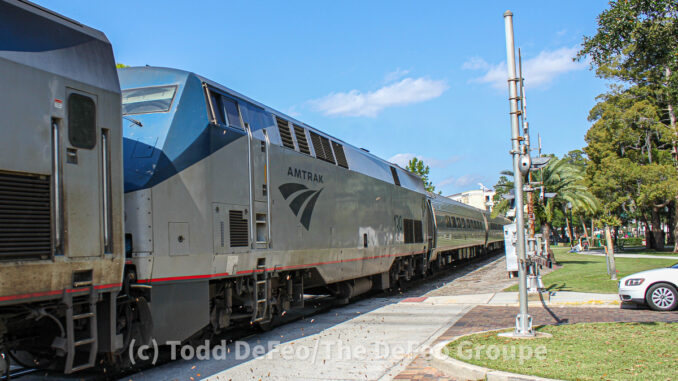
(Railfanning.org News Wire) — Amtrak is preparing to move its entire long-distance fleet toward standardized single-level passenger cars, marking a major departure from the double-deck equipment strategy the carrier has maintained for nearly half a century.
The passenger railroad formally requested proposals from manufacturers in April for more than 800 single-level passenger cars to serve 14 long-distance routes, abandoning a prior plan to buy new bi-level cars. Amtrak expects to select a manufacturer by the end of 2027, with the initial fleet replacements anticipated to enter revenue service in the early 2030s.
The move reverses a long-distance procurement philosophy established during the tenure of Paul Reistrup, who served as Amtrak’s second president starting in 1975.
Reistrup inherited an aged, mismatched collection of passenger equipment from private railroads and initiated a broad fleet modernization program. His administration launched the single-level Amfleet series and acquired the Beech Grove maintenance facility in Indiana, originally built in 1904-08 by the Cleveland, Cincinnati, Chicago & St. Louis Railway.
In 1975, he also ordered Amtrak’s first bi-level Superliner cars. The order for 235 bi-level cars was part of a $253 million order for 435 passenger cars.
The Budd Company produced the initial single-level Amfleet I cars from 1975 to 1977 for short-distance corridors, followed by the longer-distance Amfleet II fleet between 1980 and 1983. Meanwhile, Pullman-Standard delivered the first bi-level Superliners in 1979, creating extra passenger capacity on long-haul Western routes with high overhead clearances.
A second generation of Superliner II cars followed in the 1990s, making double-deck equipment synonymous with iconic trains like the California Zephyr, Empire Builder, and Southwest Chief.
That strategy created a bifurcated long-distance fleet, with single-level Viewliner and Amfleet equipment in the East and bi-level Superliners in the West. By October 2023, Amtrak’s active long-haul inventory included 217 Superliner I, 163 Superliner II, and 135 Amfleet II cars, many of which are now reaching or exceeding 40 years of continuous service.
Amtrak officials said adopting a single-level standard across all long-distance routes will simplify long-term procurement, reduce manufacturing risks, and streamline fleet maintenance and operations network-wide.
Be the first to comment