(Railfanning.org News Wire) — The Gateway Development Commission Board of Commissioners has approved a change order to the Hudson River Ground Stabilization Project contract that will add the removal of roughly 500 submerged wooden piles, left from the demolition of Pier 68, to the project’s original scope of work.
This pile removal and ground stabilization work will substantially reduce the possibility that the tunnel boring machines will encounter obstructions as they proceed through this area.
The Board authorized GDC’s Chief Executive Officer to execute the change order with Weeks Marine, the contractor currently performing the HRGS Project. The change order is valued at $88 million. Work is expected to begin in late 2026.
Today’s Board meeting took place on the two-year anniversary of GDC entering into the Full Funding Grant Agreement for the Hudson Tunnel Project. Signing this agreement was the final step in securing the $16 billion funding commitment needed to deliver the project.
In April, GDC awarded the contract for Hudson Tunnel Project Package 1C: The Hudson River Tunnel Section. This construction package will use two mixed-use tunnel-boring machines to build the new tunnel tubes beneath the Hudson River. It is one of the most technically complex construction packages because it requires tunneling through mixed conditions, including rock, soft soil, and fill that was used to expand the Manhattan shoreline.
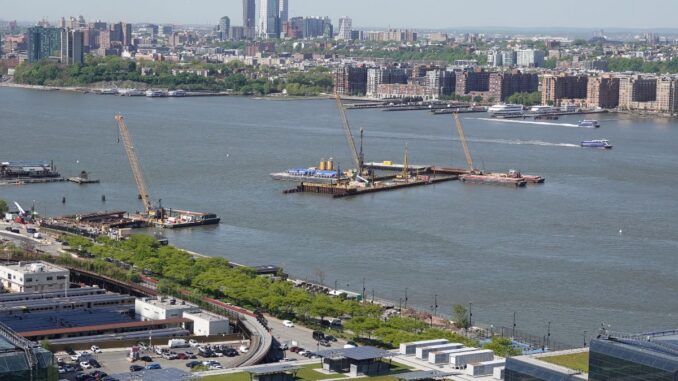
The Hudson River Ground Stabilization Project is proactively addressing factors that could adversely affect tunnel boring beneath the river. The project involves removing obstructions along the route the tunnel-boring machines will travel, then mixing lightweight concrete into the riverbed to ensure it is firm enough for the machines to bore through.
The project was originally scoped to prepare a specific 1,200-foot-long by 100-foot-wide section of the riverbed for tunnel boring. Work began in the middle of the Hudson River in 2024 and is progressing eastward toward Manhattan.
Ground stabilization is done within a temporary cofferdam to shield the work area from river currents and enable year-round construction. The contractor periodically moves the cofferdam to enclose a new section of the river. These cofferdam shifts are carefully timed to comply with environmental requirements.