
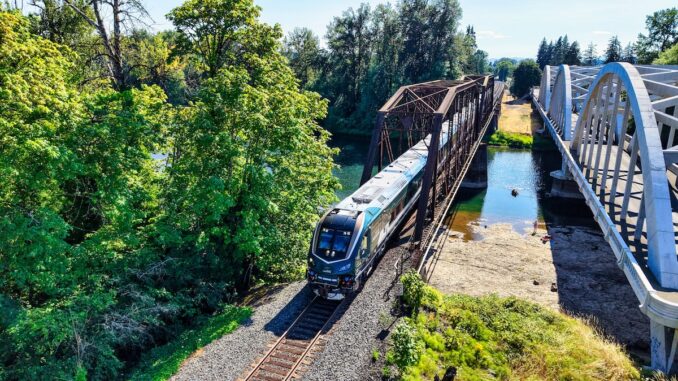
Amtrak Cascades passengers will start boarding the railroad’s new Airo trains Sept. 30, nearly two decades after Railfanning.org first documented equipment problems that disrupted the Pacific Northwest service.
Two Airo trainsets will initially enter revenue service, making four daily trips: one between Seattle and Vancouver, British Columbia and the other between Seattle and Eugene, Oregon.
Eight trainsets are ultimately headed to the Cascades, with additional equipment expected to enter service through early 2027. The Cascades will be the first Amtrak route to use Airo equipment; Northeast Regional trains are expected to follow in 2027.
For Pacific Northwest service, the fleet change has been long overdue.
Amtrak Cascades began in 1994 with one daily state-supported round trip between Seattle and Portland. Washington State Department of Transportation figures show the service has carried more than 18 million passengers since then, and it now serves 18 cities between Eugene and Vancouver.
Talgo equipment became one of its defining features: the articulated trainsets were lighter and lower than conventional Amtrak cars and used a passive tilting system intended to permit faster operation through curves, giving the Cascades a look unlike anything else in Amtrak’s system.
That distinction occasionally created problems when the equipment was unavailable. Railfanning.org reported in August 2007 that Amtrak was pulling passenger cars from elsewhere in its national fleet after small cracks were discovered in welds in the upper portions of several Talgo cars.
Engineers removed the Talgo equipment from service while they investigated; conventional Amtrak cars arrived from as far away as the East Coast, buses replaced some trains, and schedules lengthened because the substitute equipment couldn’t match the Talgo schedules.
The trains gradually returned that fall after the Federal Railroad Administration approved repairs.
By 2010, the Cascades was setting ridership records. Railfanning.org reported that second-quarter ridership reached 214,641 passengers, the route’s best second quarter since 1994.
The fleet question changed after Dec. 18, 2017, when Amtrak Cascades Train 501 derailed near DuPont, Washington, on its inaugural passenger trip over the Point Defiance Bypass. The train entered a 30 mph curve at 78 mph. Three people died, and dozens were injured.
The National Transportation Safety Board later recommended replacing the older Talgo Series 6 cars as soon as possible. Washington’s 2019 rail plan noted that the cars, built in 1999, were already approaching the end of their expected service lives and that maintenance costs were likely to increase as they aged.
Washington and Amtrak eventually retired the Series 6 equipment, and the Cascades has since relied on a mixture of conventional Horizon cars and Oregon-owned Talgo Series 8 trainsets.
Airo brings the route back to dedicated equipment. The Siemens-built trainsets have more than 300 seats, panoramic windows, improved accessibility, upgraded Wi-Fi, individual power outlets and a cafe, and Cascades equipment retains the service’s familiar evergreen, cream and mocha colors.
One significant difference from the Talgo era, though: Cascades is getting its own version of Airo, but the underlying equipment isn’t unique to the Pacific Northwest. Amtrak plans to introduce versions of the same platform on the Northeast Regional and other corridor services nationwide.
The route that spent years dealing with the complications of specialized equipment is now the first to put Amtrak’s next standardized corridor fleet into regular service.

Be the first to comment