Click here to read Part I: “Three Inches, a Nation, and a Night of Change.”
Among the many changes to the Western & Atlantic Railroad since its inception, the change of the line’s gauge in 1886 ranks among the most significant — and also among the most misunderstood.
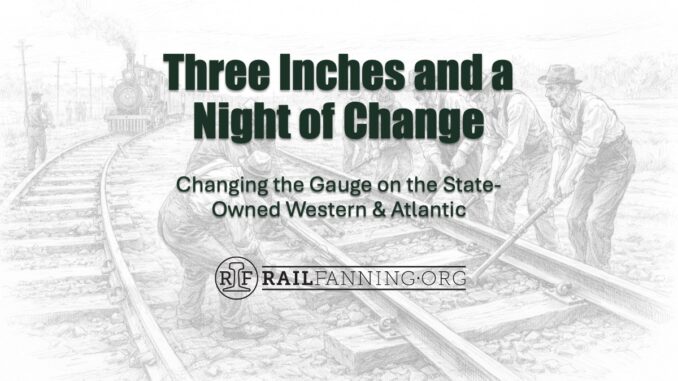
The story is often recounted as a marvel of speed: in just a few hours, teams of workers shifted one rail three inches closer to the other, converting 138 miles of track from the old five-foot gauge to the emerging national standard.
Trains ran again almost immediately. Newspapers marveled. Schedules mostly held. And then the story tends to end.
But that version, while not incorrect, is incomplete.
Throughout the nineteenth century, American railroading resembled a patchwork quilt. Each company chose its own track gauge, often guided by regional habits or the specifications of imported locomotives. Southern railroads, including the Western & Atlantic, favored a five-foot gauge, while many Northern lines adopted narrower widths based on British models.
This created a fragmented system: freight and passengers were forced to change cars at junctions — or, in some cases, to witness entire car bodies lifted off their wheels so new ones could be swapped in beneath.
For decades, that inconvenience was tolerated. Hoisting systems were slow and expensive, but railroads learned to live with them. The completion of the transcontinental railroad did not immediately force a nationwide solution, despite what later hindsight sometimes suggests. Change came slowly, driven less by ideology than by economics.
By the 1880s, however, pressure to standardize became impossible to ignore. Freight volumes soared. Connections multiplied. Interchange railroads — the lines that linked regional networks — began narrowing their gauges.
When those links were converted, railroads like the Western & Atlantic faced a stark choice: invest heavily in new hoisting equipment or adapt to the new standard.
That decision was not made lightly. Legislative approval, financial calculations, and technical debate. It also raised practical questions: How much would it cost? Could locomotives be rebuilt rather than replaced? Could hundreds of freight cars be converted without crippling daily operations?
When railroad officials finally agreed on a coordinated change in 1886, they did so knowing the risks. The gauge would change in hours — but only if months of painstaking planning unfolded without a hitch.
And that is the part of the story that deserves closer attention.
Check back next week for the next installment.