Click here to read Part I: “Three Inches, a Nation, and a Night of Change.”
Click here to read Part II: “Three Inches That Changed Everything.”
The Western & Atlantic Railroad’s gauge did not change overnight by accident.
A year before the scheduled conversion, work was already underway. In shops along the line, machinists rebuilt locomotives by replacing wheel centers and adjusting axles.
Freight cars were quietly sidelined, jacked up, and regauged before being returned to service. Passenger equipment received entirely new wheelsets.
By the spring of 1886, hundreds of cars and dozens of engines were ready — waiting.
Along the tracks themselves, the preparation was even more methodical. Crews drove extra spikes into the crossties along the entire line from Atlanta to Chattanooga.
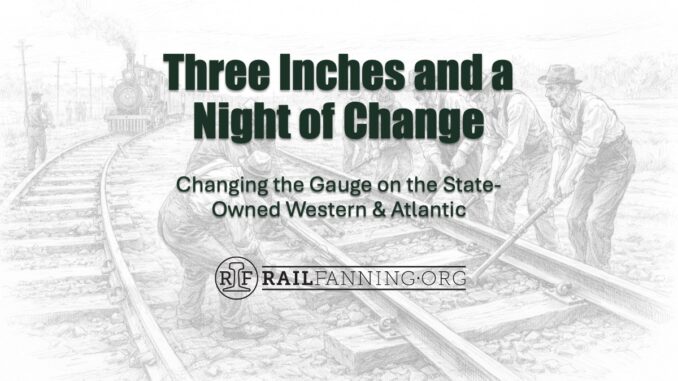
These spikes were placed exactly three inches inward from the existing rail. The idea was simple and brilliant: when the day came, workers would not measure, argue, or improvise. They would pull one rail loose, shove it against the waiting spikes, and secure it.
On May 31, 1886, the last five‑foot‑gauge trains ran their routes. One bore flags reading “THE LAST TRAIN.” As soon as it cleared the line, crews moved in.
More than 400 men worked in coordinated sections, each overseen by experienced supervisors assigned by milepost. Curves and straightaways had been planned in advance. Side tracks were included.
By mid‑morning on June 1, the work was done. The final spikes were driven not far from present‑day Smyrna.
By afternoon, trains were running again — some on time, others only slightly delayed. Compared to the chaos many expected, the transition was remarkably smooth. In fact, the Western & Atlantic performed better than many of its peers.
What made the feat possible was not speed alone, but discipline: a year of quiet preparation culminating in one tightly choreographed day. It was an achievement shared by engineers, machinists, laborers, and overseers — many of whose names are now lost to history.
They quite literally moved the railroad.
And in doing so, they helped bind a fragmented system into something closer to a national network — one measured not in feet, but in foresight.