
Friday, May 9, 1980, was a watershed day in Amtrak history.
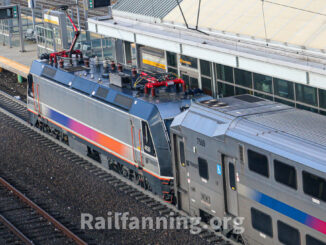
On this day, Amtrak officially christened its new AEM-7 electric locomotive at Washington Union Station—a milestone that would reshape Northeast Corridor service.
U.S. Rep. Robert Edgar, D-Pennsylvania, performed the ceremonial christening by smashing a bottle of champagne against the nose of locomotive No. 901. The event also featured several speakers, including P.K. Hoglund, general manager of the Electro-Motive Division of General Motors, and Arne Mark, president of ASEA Inc.
After the ceremony, No. 901 powered an Amfleet train as Metroliner No. 105, then returned as Metroliner No. 119 departing New York at 3:30 p.m. Notably, this AEM-7 was only the second unit delivered to Amtrak.
The first unit, No. 900, was still undergoing rigorous endurance testing at the Department of Transportation’s Pueblo, Colorado, facility.
“The AEM-7 has passed its acceptance tests with greater ease than any other locomotive Amtrak has purchased,” Tom Hackney, Amtrak’s group vice president of operations and maintenance, said at the time. “It is anticipated that it is fully capable of meeting our existing Metroliner schedules and the two-hour-40-minute schedules, between Washington and New York, to be implemented at the completion of the Northeast Corridor Improvement Project.
“We certainly expect it will improve on-time reliability of our locomotive-hauled trains in the Corridor,” Hackney added.
The AEM-7 locomotives boasted 7,000 horsepower, were tested at speeds up to 125 miles per hour and were designed to provide reliable service as mandated by the Railroad Revitalization and Regulatory Reform Act.
The AEM-7 also served the New York-Boston route after electrification was extended from New Haven to Boston.
At introduction, the AEM-7 became Amtrak’s most energy-efficient electric locomotive, consuming about 10 percent less energy than the E60CP and 20 percent less than the legendary GG1 it replaced.
“I’ll miss the GG-1,” The Star-Ledger newspaper of Newark, New Jersey, quoted Harold G. Gunther, the regular engineer on Metroliner No. 108, as saying. “I’ve been running those GG-Is since 1955. I hope this engine does as well.”
The AEM-7 was based on a Swedish design by ASEA, with modifications to meet Amtrak’s specific needs in the Corridor. Hence, they were affectionately dubbed “Swedish Meatballs” by railfans.
Amtrak initially ordered 47 AEM-7s at a cost of $135.6 million, according to a UPI report from the era, and subsequently expanded the fleet with additional units.
The first AEM-7 arrived in January 1980. Amtrak anticipated that subsequent units would arrive at a rate of 2 per month, boosting high-speed service and enabling the retirement of aging GG1 locomotives from Amfleet-equipped trains on the Washington-to-New Haven electrified segment of the Corridor.
The last AEM-7 was retired in June 2016, bringing to a close an era spanning nearly four decades.