(Railfanning.org News Wire) — The driver of a passenger train was killed, and 162 people were injured when two East Midlands Railway trains collided south of Bedford, according to preliminary findings released by British rail investigators.
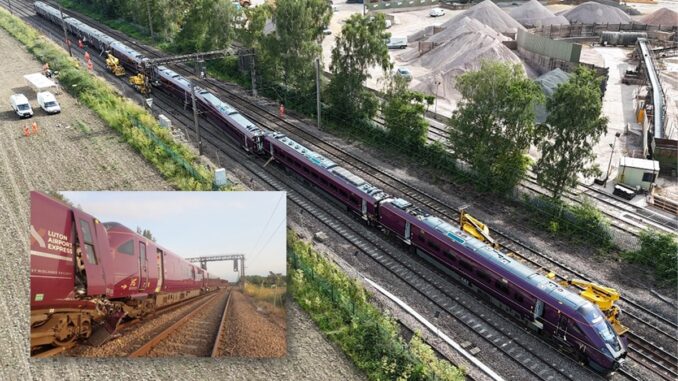
The collision happened at about 5:15 p.m. on June 19 on the Midland Main Line near Elstow, about 2.5 miles south of Bedford station. Train 1H46, the 4:40 p.m. service from Corby to London St Pancras, collided with train 1B67, the 3:50 p.m. Nottingham-to-London St Pancras service.
The driver of train 1H46 died. Of the 162 people injured, 102 required hospital treatment. As of June 24, 53 remained hospitalized, including eight in critical condition, the Rail Accident Investigation Branch said.
Both trains partially derailed and sustained significant damage.
RAIB’s preliminary examination found that train 1B67 had stopped unexpectedly beside signal WH152 after a fault in its Automatic Warning System caused the brakes to apply. Railway data showed that the track section occupied by the stopped train should have caused the signal WH154 behind it to display red to protect it from following movements.
Train 1H46 left Bedford station at about 5:10 p.m. on the Up Slow line. Forward-facing camera footage showed it passing two yellow caution signals before crossing onto the Up Fast line at Bedford South Junction.
Investigators said signal WH154 was displaying red as train 1H46 approached and passed it.
Preliminary data from the rear vehicle’s on-train recorder showed a brake application about nine seconds before the collision, when the train was traveling about 76 mph. The train was moving at approximately 49 mph when it struck the stopped service.
RAIB said investigators are still analyzing the recorder from the front vehicle and cannot yet say what warning the driver received from the train’s AWS equipment or how the driver responded.
The investigation will examine the actions of those involved, the braking and safety systems aboard train 1H46, the fault that stopped train 1B67 and the condition, visibility and performance of signal WH154 and its warning equipment.
Investigators will also review the crash-worthiness of both trains, the emergency response, the assessment of overrun risks at the location and any actions taken following previous safety recommendations.
RAIB said some preliminary information could change as evidence is analyzed. A final report will include findings and any recommendations intended to improve railway safety.