On Sept. 15, 1896, the Missouri-Kansas-Texas Railroad, better known as the Katy, staged a head-on collision between two uncrewed steam locomotives at a temporary event site near Waco, Texas, called Crush.
The idea was the brainchild of William George Crush, the railroad’s general passenger agent, who pitched the event as both spectacle and marketing coup. Admission was free, and discounted $2 round-trip fares from anywhere in Texas helped to attract a staggering 40,000 spectators to witness the crash.
Officials expected a crowd, but not one this large.
Crowd control quickly unraveled, delaying the collision by an hour as police pushed spectators back. While most were kept 200 yards from the track, journalists were allowed closer.
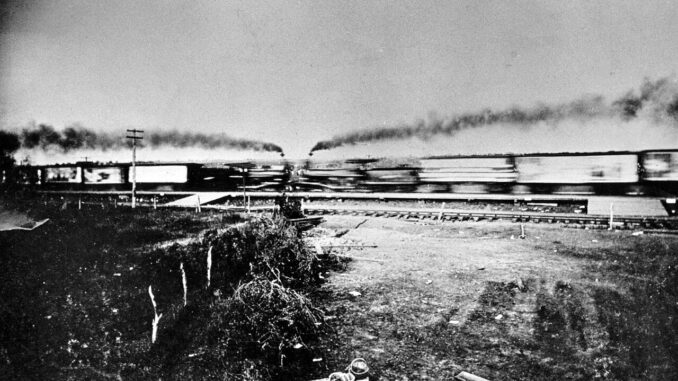
The spectacle was carefully choreographed. The engines, hauling boxcars and cars loaded with railroad ties, posed for photos, then backed to opposite ends of the track.
At the signal, crews opened the throttles, then quickly jumped clear as the locomotives hurled toward each other and the history books.
“The rumble of the two trains, faint and far off at first, but growing nearer and more distinct with each fleeting second, was like the gathering force of a cyclone,” The Dallas Morning News reported on Sept. 16, 1896. “Nearer and nearer they came, the whistles of each blowing repeatedly and the torpedoes which had been placed on the track exploding in almost a continuous round like the rattle of musketry.
“…They rolled down at a frightful rate of speed to within a quarter of a mile of each other,” the newspaper added. “Nearer and nearer as they approached the fatal meeting place the rumbling increased, the roaring grew louder.”
The trains reportedly collided at about 45 mph. However, some claimed they were traveling faster.
But no one anticipated the crash’s violence. Despite assurances that the boilers would hold, both exploded, hurling shrapnel into the crowd. Two people were killed, and many more were injured.
“All that remained of the two engines and twelve cars was a smoking mass of fractured metal and kindling wood, except one car on the rear of each train, which had been left untouched,” The Dallas Morning News reported on Sept. 16, 1896. “The engines had both been completely telescoped, and contrary to experience in such cases, instead of rising in the air from the force of the blow, were just flattened out. There was nothing about the cars big enough to save except pieces of wood, which were eagerly seized upon and carried home as souvenirs.”
The disaster made national headlines. Crush, who joined the railroad in 1893, was publicly fired, then quietly rehired the next day and remained with the company for decades until he retired in 1940 at the age of 74.
The railroad quickly settled claims — including a payout to photographer Jarvis “Joe” Deane of Waco, who lost an eye to a flying bolt — while still reaping publicity from the event. The Crash at Crush was one of at least 100 staged locomotive crashes between the 1890s and the 1930s.