Overview
Chartered by the Commonwealth of Pennsylvania in 1846, the Pennsylvania Railroad grew from a regional carrier into one of the most powerful corporations in American history. By the late 19th century, it controlled thousands of miles of track and had become the dominant railroad between New York, Philadelphia, Baltimore, Washington, and points west.
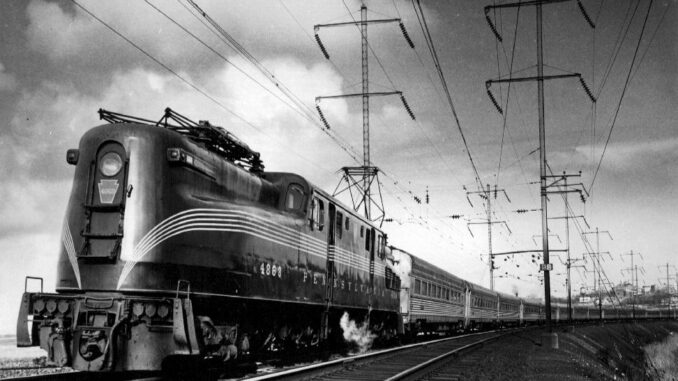
The railroad gained access to the New York metropolitan area through its 1871 lease of the United New Jersey Railroad and Canal Company, a move that laid the foundation for the modern Northeast Corridor. The Pennsylvania Railroad engineered many of the corridor’s defining landmarks, including New York’s Penn Station, the Hudson River tunnels, and the electrified main line between New York and Washington. In the 1930s, it completed one of the world’s largest railroad electrification projects and introduced the iconic GG1 locomotive.
Long known as the “Standard Railroad of the World,” the Pennsylvania Railroad merged with its rival, the New York Central, in 1968 to form Penn Central, bringing an end to one of the most influential railroads in American history.
Quick Facts
- Abbreviation
- PRR
- Type
- Railroad
- Founded
- 1846
- Ended
- 1968
- Headquarters
- Philadelphia, Pennsylvania
- Geographic area
- New Jersey;New York;Pennsylvania
- Disposition
- Merged with the New York Central to form Penn Central
Place
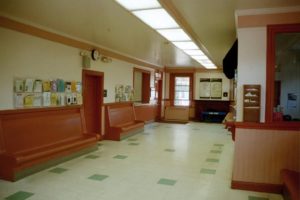
Metuchen Station
Metuchen Station, as it stands today, dates to 1888 and occupies a prominent location at the end of the borough's downtown business district.
Place
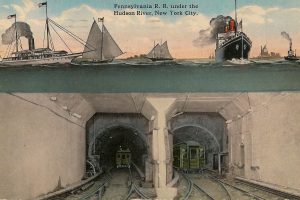
North River Tunnels
In December 1901, Alexander Cassatt, president of the Pennsylvania Railroad, announced a bold plan to build a tunnel beneath the North River (Hudson River).
Place
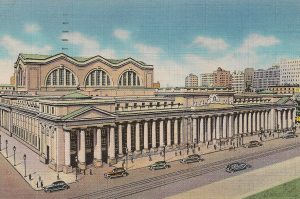
Pennsylvania Station
The new Penn Station in New York City opened in 1910.